
Introduction: What Determines Custom Silicone Mold Lifespan?
When developing custom silicone components, one of the most critical questions from procurement directors, toolmakers, and product engineers is simple: How long will the mold last? However, determining the true custom silicone mold lifespan involves far more variables than quoting an arbitrary production cycle number on a preliminary quotation.
A production mold does not possess a static lifecycle. Its operational durability depends on an interconnected manufacturing system: tool steel metallurgy, cavity relief depth, hydraulic clamping pressure, vulcanization operating temperatures, parting line engineering, demolding mechanics, and continuous shop-floor maintenance protocols.
For OEM, ODM, and private-label programs, tool steel selection directly dictates initial CNC machining costs, surface polishability, micro-cavity wear resistance, and long-term dimensional repeatability. At LIREN SILICONE, our specialized custom silicone mold manufacturing evaluates tooling metallurgy according to the functional requirements of the part and expected multi-year production volumes rather than defaulting to generic materials.
Table of Contents (Jump to Engineering Section)
- Primary Engineering Variables Dictating Custom Silicone Mold Lifespan
- Tool Steel Selection: The Core Lifespan Matrix
- Comparative Analysis: 5 Common Tool Steels Evaluated
- Does Harder Steel Always Guarantee Longer Tooling Life?
- Why Mold Design Outweighs Steel Grade Selection
- How Shop-Floor Production Conditions Accelerate Wear
- Can Silicone Tooling Reach 100,000+ Production Cycles?
- Tooling Life vs. Product Commercial Lifecycle
- Matching Steel Grades to Target Production Volumes
- Total Cost of Ownership vs. Initial Tooling Quotations
- Warning Signs a Mold Requires Maintenance or Rework
- 7 Technical Inquiries OEM Buyers Should Verify Before Tooling
This technical guide details the critical factors influencing custom silicone mold lifespan, providing a realistic comparative analysis of 50# carbon steel, P20, 718, S136H, and NAK80 to support informed sourcing decisions before cutting tool steel.

1. Primary Engineering Variables Dictating Custom Silicone Mold Lifespan
A mold does not carry a guaranteed lifecycle purely because a specific steel designation was chosen. Two compression molds built from the same steel batch can demonstrate substantially different operational lifecycles, directly affecting the overall custom silicone mold lifespan depending on part geometry and operational discipline.
When calculating practical custom silicone mold lifespan, toolmakers examine twelve core variables:
- Raw Steel Ingot Quality: Metallurgical purity, vacuum degassing, and grain structure.
- Through-Hardness Uniformity: Consistent Rockwell C (HRC) levels from surface lands to cavity cores.
- Part Geometry Complexity: Deep 3D reliefs versus flat, planar designs.
- Undercuts & Demolding Elasticity: Friction applied across steel ribs during manual or pneumatic stripping.
- Hydraulic Clamp Tonnage: Excessive press tonnage causing coining or deformation along shut-off lands.
- Vulcanization Thermal Cycling: Continuous heating cycles operating between 165°C and 185°C.
- Daily Cycling Frequency: Continuous high-output manufacturing versus intermittent production runs.
- Cavity Surface Specifications: SPI optical mirror finishes versus EDM fine-matte textures.
- Flash Control Architecture: Shut-off land width, tear-trim groove clearance, and overflow reservoirs.
- Operator Handling Standards: Using non-marring copper/brass tools versus hardened steel picks for demolding.
- Preventative Cleaning Schedules: Regular dry-ice blasting, ultrasonic degassing, and anti-corrosion storage lubrication.
- Project Volume Horizons: Short-run commercial trials versus multi-year serial manufacturing.
2. Tool Steel Selection: The Core Lifespan Matrix
Tool steel directly governs CNC milling speeds, cutter deflection, EDM sparking duration, cavity polishability, and the multi-year custom silicone mold lifespan. Consequently, no single mold steel serves as a universal choice for all products. A short-run promotional project cannot justify the investment of high-grade stainless tooling, whereas high-volume OEM components will face costly downtime if cut from basic carbon steel.
| Steel Grade | Typical Hardness* | Expected Cycle Life | Core Manufacturing Advantages | Engineering Considerations |
|---|---|---|---|---|
| 50# Steel | HRC 8 – 12 (Annealed / Soft) |
5,000 – 15,000 cycles | Lowest initial tooling cost; fast CNC machining; minimal cutter wear. | Low wear resistance; parting line edges crush easily under hydraulic clamp loads. |
| P20 | HRC 28 – 30 (DIN 1.2311) |
100,000 – 200,000 cycles | Pre-hardened standard; reliable mechanical strength; cost-effective for production. | Moderate CNC processing times; limited suitability for SPI optical mirror polish. |
| 718 / 718H | HRC 30 – 32 (DIN 1.2738) |
300,000 – 500,000 cycles | Nickel-alloyed for uniform density; high wear resistance; stable CNC cutting. | Higher material cost than P20; generally not utilized for ultra-high-polish medical optics. |
| S136H | HRC 32 – 36 (AISI 420 Mod) |
500,000+ cycles | Corrosion resistance against curing off-gases; exceptional mirror polishability. | Higher tooling investment; requires high-volume or premium cosmetic justification. |
| NAK80 | HRC 38 – 42 (Precipitation Hardened) |
500,000+ cycles | Uniform pre-hardened structure; zero heat-treatment distortion; minimal cavity wear. | Premium material cost; high hardness increases difficulty of subsequent weld modifications. |
*Note: Hardness ranges represent practical baseline parameters utilized in commercial tooling according to standardized ASTM A681 alloy tool steel specifications. Actual delivered hardness varies with heat treatment and thermal stabilization cycles.
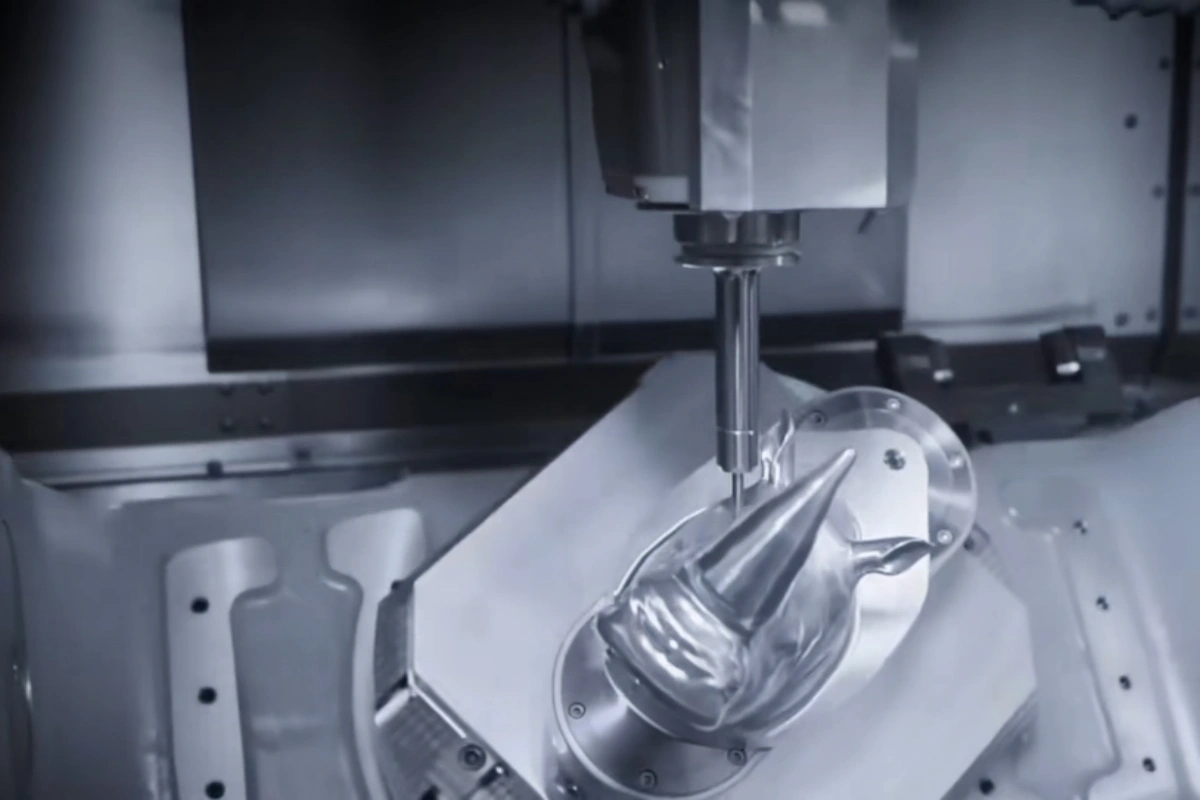
3. Comparative Analysis: 5 Common Tool Steels Evaluated
50# Medium Carbon Steel — Cost-Oriented Prototyping
50# medium carbon steel is a standard entry-level tooling metal. Its primary commercial appeal is lower initial tooling expenditure. Because the steel is comparatively soft in its unquenched state (HRC 8–12), CNC milling cutters operate efficiently with minimal tool wear, helping reduce lead times for early validation prototypes.
However, under 150-to-200-ton hydraulic compression presses, 50# steel displays limited fatigue resistance along parting-line shut-off lands. These critical borders gradually deform over repetitive cycles, leading to visible flash and a shortened custom silicone mold lifespan after a few thousand production cycles. It is best applied for low-volume promotional projects, market testing, or simple geometric evaluations.
P20 Steel — The Baseline Standard for Serial Production
P20 (DIN 1.2311) provides a significant improvement in hardness and structural stability over carbon steel. Delivered pre-hardened to roughly HRC 28–30, P20 withstands mechanical clamp pressures without early edge deformation while maintaining good machinability.
For standard consumer kitchenware, household tools, and industrial silicone gaskets where functional durability is prioritized over optical mirror surfaces, P20 delivers an optimal balance of tooling cost, multi-year production stability, and predictable custom silicone mold lifespan.
718 / 718H Steel — High-Density Pre-Hardened Tooling for Long Runs
718 (DIN 1.2738) is a modified pre-hardened mold steel formulated with approximately 1% nickel. This alloy composition improves through-hardness uniformity across large mold plates, providing a consistent HRC 30–32 (with 718H reaching HRC 34–38).
Because its metallurgical microstructure is dense and uniform, 718 resists mechanical fatigue under rapid cycling. It is widely specified for commercial bakeware, suction plates, and branded accessories where long-term dimensional repeatability is required.
S136H — Stainless Grade for Corrosion Resistance and Fine Textures
For infant feeding products, medical-grade components, and high-gloss cosmetics, S136H (AISI 420 modified) is our primary recommendation. Pre-hardened to HRC 32–36, this martensitic stainless steel resists corrosive degradation caused by vulcanization off-gases and shop-floor cleaning chemicals.
Crucially, S136H supports high-grade diamond polishing (SPI A-1 / A-2) and laser texture replication. Although raw material and machining costs are higher, the mold maintains its cavity finish across hundreds of thousands of cycles without corrosion risks during storage, thereby maximizing the custom silicone mold lifespan for medical and food-grade lines.
NAK80 — High-Hardness Steel for Demanding Geometries
NAK80 is a precipitation-hardening mold steel supplied at a uniform HRC 38–42. Because it achieves its target hardness through precipitation rather than secondary quenching, it exhibits high dimensional stability and minimal residual internal stress.
NAK80 is well-suited for high-cavity tools where minor parting-line wear would compromise part tolerances. However, its high hardness requires controlled CNC cutting parameters, and subsequent engineering modifications or laser welding repairs are technically challenging.
Need an Engineering DFM Review for Your Silicone Mold?
Avoid expensive tooling modifications before cutting steel.
Send us your 3D CAD files (STEP, STP, IGS) or product concept. Our toolmakers evaluate wall-thickness consistency, shrinkage rates, parting line paths, and demolding feasibility under strict NDA protection.
4. Does Harder Steel Always Guarantee Longer Tooling Life?
No. This is an important distinction for OEM sourcing teams.
A mold machined from NAK80 can still experience operational issues within a few thousand cycles if demolding draft angles are insufficient or if hydraulic clamp pressure exceeds the yield limits of narrow shut-off lands. Steel hardness improves abrasive wear resistance, but it cannot offset fundamental design flaws.
A premium steel grade cannot compensate for:
- Improper parting-line orientation leading to heavy flash
- Inadequate micro-venting resulting in trapped air and scorched edges
- Zero-draft vertical walls causing demolding tears
- Severe wall-thickness variations triggering differential thermal stresses
- Improper handling tools such as hard steel picks used during demolding
An optimal custom silicone mold lifespan is achieved when appropriate steel selection is matched with rigorous DFM engineering, controlled press parameters, and standardized maintenance.

5. Why Mold Design Outweighs Steel Grade Selection
In custom silicone manufacturing, part 3D geometry dictates the magnitude of mechanical stress applied to the mold cavity during every hydraulic cycle. Before cutting tool steel, adhering to structured silicone mold design guidelines is essential to ensure operational longevity.
To safeguard the expected custom silicone mold lifespan, a professional DFM engineering review examines:
- Parting Line Geography: Locating parting lands along natural edges to ensure clean compound cut-off without localized steel crushing.
- Wall Thickness Uniformity: Maintaining core thicknesses between 1.2 mm and 2.0 mm to avoid severe thermal gradients across cavity plates.
- Undercut Demolding Mechanisms: Designing elastic stripping clearances or mechanical side-slides to prevent cavity edge stress during extraction.
- Micro-Venting Integration: Machining 15–30 μm gas vents at material convergence points to eliminate diesel-effect scorching.
6. How Shop-Floor Production Conditions Accelerate Wear
When assessing manufacturing methods, comparing silicone compression molding vs injection molding illustrates how production conditions influence tool wear. Solid silicone compression molding subjects steel plates to continuous physical cycles:
Raw Compound Loading → Hydraulic Clamping → Thermal Vulcanization (175°C) → Platen Separation → Part Stripping → Cavity Cleaning
Over thousands of production cycles, operational practices directly impact mold condition and reduce the practical custom silicone mold lifespan:
- Excessive Hydraulic Tonnage: Clamping beyond engineering requirements deforms narrow shut-off lands, permanently widening the parting gap.
- Abrasive Demolding Tools: Using hardened steel scrapers to remove parts can scratch polished cavity walls.
- Thermal Shock During Cleaning: Applying room-temperature liquid chemicals onto 180°C tooling can cause micro-surface thermal fatigue over time.
7. Can Silicone Tooling Reach 100,000+ Production Cycles?
Yes. Production tooling built with quality steels (such as P20, 718, or S136H) and operated under controlled manufacturing conditions can achieve a custom silicone mold lifespan exceeding 100,000 to 300,000+ cycles.
However, stating an identical cycle guarantee across all designs is technically inaccurate. A simple, symmetrical 4-cavity silicone coaster mold experiences minimal extraction friction and can operate through 300,000 cycles with minor maintenance. In contrast, an intricate 3D baby teether mold with multiple undercuts experiences greater stripping resistance, requiring regular servicing.
For high-volume planning, realistic tool life estimation is evaluated as:
Estimated Tooling Lifespan = Target Annual Volume × Parting Geometry Factor × Steel Fatigue Limit × Maintenance Compliance
8. Tooling Life vs. Product Commercial Lifecycle
A practical sourcing principle is distinguishing between physical custom silicone mold lifespan and the product’s commercial market lifecycle.
A mold fabricated from S136H stainless steel may remain structurally sound for years, but if the product is a seasonal item intended for a single promotional cycle, premium steel creates unnecessary upfront capital expenditure. Conversely, for established product lines such as infant feeding items, reusable kitchenware, or proprietary industrial components, investing in 718 or S136H provides substantial value by preventing mid-lifecycle tooling replacements.
9. Matching Steel Grades to Target Production Volumes
Procurement teams can optimize capital efficiency by matching expected volumes with tool steel properties:
- Pilot Runs / Low Volume (< 10,000 units): 50# carbon steel or standard P20 is practical when designs may undergo functional revisions.
- Mid-Scale Commercial Production (20,000 – 100,000 units): P20 or 718 provides reliable shut-off durability, consistent parting lines, and balanced lead times.
- High-Volume Serial Supply (100,000+ units): 718H, S136H, or NAK80 is recommended to maintain cavity tolerances, surface finishes, and flash-free parting lines over multi-year runs.
10. Total Cost of Ownership vs. Initial Tooling Quotations
A lower upfront mold quotation does not necessarily equate to a lower overall manufacturing cost or a satisfactory custom silicone mold lifespan. Consider two scenarios:
- Scenario A (Entry-Level Tooling): A soft steel mold quoted at $2,500. Parting lines begin flashing at 12,000 cycles due to shut-off land wear, necessitating manual trimming labor, downtime for mold rework, and replacement tooling after 18 months.
- Scenario B (Production-Grade Tooling): A 718 or S136H mold quoted at $4,200. Precision shut-offs operate past 150,000 cycles with standard preventative maintenance, zero unplanned line shutdowns, and consistent tear-trim flash.
Scenario A frequently results in higher cumulative expenditure due to scrap rates, secondary trimming labor, and tool re-fabrication. Evaluating tooling through a Total Cost of Ownership (TCO) perspective protects project margins across the full production lifecycle.

11. Warning Signs a Mold Requires Maintenance or Rework
Tooling wear develops progressively. Identifying early wear indicators enables technicians to polish, adjust, or rework cavity inserts before critical damage occurs:
- Progressive Parting-Line Flash: Flash thickness exceeding 0.05 mm indicates land fatigue or clamp-plate misclosure.
- Cavity Surface Haze & Micro-Pitting: Acidic curing off-gases degrading non-stainless, unplated steel surfaces over time.
- Increased Demolding Drag: Micro-scuffing on cavity sidewalls increasing extraction resistance and part tear rates.
- Critical Dimensional Creep: Precision sealing lips or mating grooves drifting outside required engineering tolerance limits.
12. 7 Technical Inquiries OEM Buyers Should Verify Before Tooling
Prior to approving production tooling, procurement and engineering teams should review these seven technical checkpoints with their supplier:
- What specific tool steel grade and material standard will be specified for the mold plates and cavity inserts?
- Is an engineering DFM review included prior to CNC machining?
- What shrinkage rate is calculated for the specified silicone compound?
- How will parting line shut-offs and tear-trim grooves be configured to control flash?
- What draft angles are engineered along vertical cavity walls?
- Can cavity inserts be replaced or modified if product revisions occur?
- What preventative cleaning and storage protocols are implemented during production?
How LIREN SILICONE Safeguards OEM Tooling Assets
At LIREN SILICONE, our integrated silicone mold manufacturing process approaches custom tooling as a long-term production asset. Rather than machining tool steel immediately upon CAD receipt, our engineering team conducts thorough DFM feasibility audits to ensure part geometries support clean release, balanced thermal cycles, and reliable flash control.
Supported by our specialized tooling facilities featuring in-house high-speed CNC machining, mirror EDM capabilities, and structured tool-maintenance protocols, we assist global brands in optimizing their custom silicone mold lifespan from early T1 prototypes through multi-year production runs.
Ready to Build Production-Grade Custom Silicone Molds?
Partner directly with an engineering-focused factory in China.
Whether you are producing precision food bakeware, custom kitchenware, or infant-grade silicone products, we provide turnkey tooling design, rapid prototyping, and volume manufacturing under ISO quality controls. Contact our technical team today to receive a detailed DFM report and official factory quote.
Conclusion: Tooling Longevity Is an Engineering Strategy
Achieving an optimal custom silicone mold lifespan is an intentional engineering outcome. Selecting the appropriate steel grade—whether economical 50# for early validation, durable P20 and 718 for standard OEM programs, or corrosion-resistant S136H and NAK80 for high-volume applications—safeguards capital investments while ensuring consistent manufacturing quality.
By collaborating with an engineering-focused manufacturing partner that aligns tooling design with your commercial volume goals, OEM brands can avoid premature tool wear, control overall part costs, and maintain high dimensional repeatability across production lifecycles.